
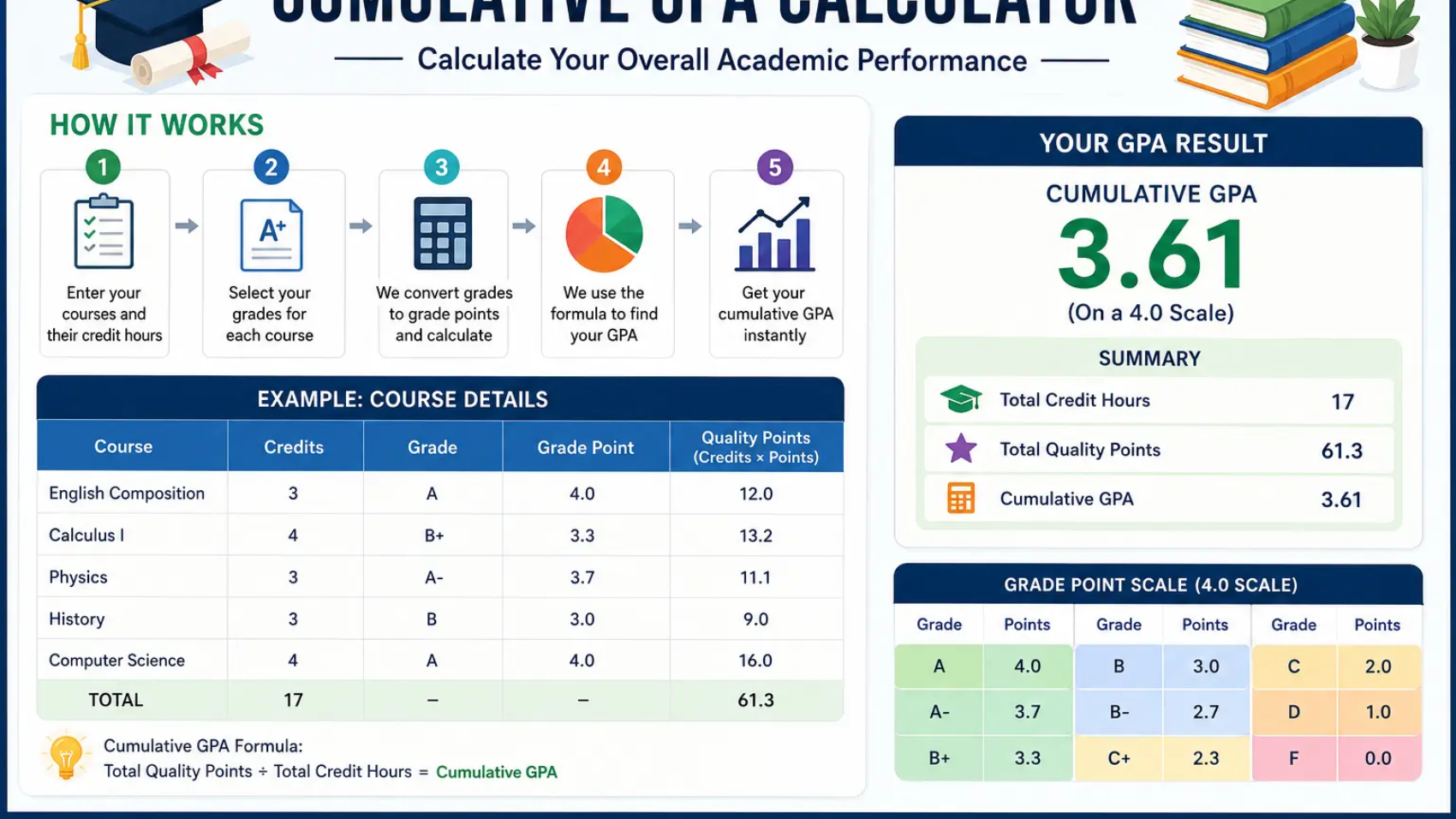
A cumulative GPA calculator helps students find their overall Grade Point Average across all semesters. It combines grades from different courses and terms into one score. This score shows your full academic performance. Many schools, colleges, and universities use cumulative GPA to review student progress.
Students often check GPA before applying for scholarships, internships, and degree programs. A good GPA can open many academic opportunities. It can also help you set clear study goals. Therefore, a GPA calculator saves time and reduces errors during calculations.
The cumulative GPA calculator is one of the most useful academic tools for students. It gives fast results and helps track progress during a study journey. You know, many students feel confused when they calculate GPA by hand. This tool makes the process simple and easy to understand.
Look, GPA is not only a number. It reflects effort, learning, and consistency. A cumulative GPA calculator helps students stay informed about their academic standing. As a result, they can make better decisions for future semesters.
What Is a Cumulative GPA Calculator
A cumulative GPA calculator is an online or manual tool that calculates the average grade points earned during all completed semesters. Unlike a semester GPA calculator, it includes every course taken throughout an academic program. Therefore, it gives a complete view of academic performance.
The calculator uses credit hours and grade points to produce a final GPA. Each course carries a certain number of credits. At the same time, each grade has a specific point value. The calculator combines both values and then finds the weighted average. Students use this tool to estimate future GPA goals. They also use it to check whether they meet graduation requirements.
Trust me, this can help reduce stress before important academic decisions. Many colleges follow a 4.0 GPA scale. However, some schools use different grading systems. A cumulative GPA calculator can often support various grading scales. Because of this flexibility, students from different institutions can use the same tool.
Why Cumulative GPA Matters
Cumulative GPA plays a major role in academic life. Schools often use it to determine academic standing. A strong GPA can improve scholarship opportunities and program eligibility. Therefore, students should monitor it regularly. Many employers review GPA when hiring recent graduates. Although experience matters, GPA can still reflect discipline and learning ability. As a result, students with strong academic records may gain an advantage during recruitment.
Graduate schools also consider cumulative GPA during admissions. Admission committees often review transcripts and GPA together. Therefore, maintaining a healthy GPA can support future education plans. Bro, GPA also helps students evaluate their study habits. When GPA improves, students can see that their efforts bring results. This creates motivation and encourages continued academic growth.
Difference Between Semester GPA and Cumulative GPA
Semester GPA measures academic performance during one specific semester. It only includes courses completed during that term. Therefore, it provides a short-term academic snapshot. Cumulative GPA includes every completed course across all semesters. It combines all academic records into one overall score.
As a result, it gives a broader picture of student performance. Students often confuse these two GPA types. However, each serves a different purpose. Semester GPA tracks current progress, while cumulative GPA tracks overall academic achievement.
Both measurements have value. Semester GPA helps identify immediate strengths and weaknesses. Meanwhile, cumulative GPA shows long-term consistency and academic development.
Semester GPA vs Cumulative GPA
| Feature | Semester GPA | Cumulative GPA |
| Covers One Semester | Yes | No |
| Covers All Semesters | No | Yes |
| Shows Current Progress | Yes | Limited |
| Shows Overall Performance | No | Yes |
| Used for Graduation Review | Sometimes | Often |
How GPA Works on a 4.0 Scale
Most colleges use a 4.0 GPA scale. Under this system, each letter grade receives a numerical value. Students earn grade points based on course performance. An A grade usually equals 4.0 points. A B grade equals 3.0 points. Likewise, a C grade equals 2.0 points. Lower grades receive fewer points.
Therefore, higher grades lead to a stronger GPA. Credit hours also affect GPA. Courses with more credits carry more weight during calculations. Because of this, performance in high-credit courses can influence GPA more strongly. The 4.0 scale remains one of the most common grading systems worldwide. It helps institutions evaluate academic achievement through a standardized method.
Common GPA Scale
| Letter Grade | Grade Points |
| A | 4.0 |
| A- | 3.7 |
| B+ | 3.3 |
| B | 3.0 |
| B- | 2.7 |
| C+ | 2.3 |
| C | 2.0 |
| D | 1.0 |
| F | 0.0 |
Components Used in a Cumulative GPA Calculation
Several components contribute to cumulative GPA calculations. The first component is grade points. These points come from the grades earned in each course. The second component is credit hours. Each course has a credit value based on workload and class time. Courses with more credits affect GPA more significantly.
The third component is total quality points. Quality points result from multiplying grade points by credit hours. Therefore, they represent the weighted value of academic performance. Finally, total credit hours determine the denominator of the GPA formula. The calculator divides total quality points by total credits. This produces the final cumulative GPA.
Basic Formula for Cumulative GPA
The formula for cumulative GPA remains straightforward. Students add all quality points earned across completed courses. Then they divide this total by all completed credit hours. The formula looks simple, yet accuracy matters. Even a small mistake can change the final GPA. Therefore, many students prefer using a cumulative GPA calculator.
A calculator performs calculations instantly. It also reduces human error. As a result, students receive reliable GPA estimates within seconds. Like many academic tools, GPA calculators help students focus more on planning and less on manual calculations.
Formula
Cumulative GPA = Total Quality Points ÷ Total Credit Hours
Step-by-Step Method to Calculate Cumulative GPA
Step 1: Gather Academic Records
Collect all completed courses and grades. Include every semester that contributes to your academic record. Accurate information ensures accurate results.
Step 2: Identify Credit Hours
Check the credit hours assigned to each course. These values usually appear on transcripts or course outlines. Every credit hour plays a role in GPA calculations.
Step 3: Convert Grades to Points
Match each letter grade with its grade-point value. Most institutions provide a grading scale for students. Therefore, this step remains simple.
Step 4: Calculate Quality Points
Multiply grade points by credit hours for every course. This creates quality points for each subject. Then add all quality points together.
Step 5: Divide by Total Credits
Add all credit hours from completed courses. Finally, divide total quality points by total credits. The result is your cumulative GPA.
Benefits of Using a Cumulative GPA Calculator
A cumulative GPA calculator offers many benefits for students. First, it saves time. Manual calculations often take several minutes, especially when students have many courses. Therefore, a calculator provides results much faster. The tool also improves accuracy. Small math errors can change GPA results.
Because of this, many students trust GPA calculators for dependable calculations. Accurate information helps students make informed academic decisions. Another benefit involves academic planning. Students can test different grade scenarios before a semester ends.
As a result, they can understand how future grades may affect their overall GPA. You know, GPA tracking becomes easier when students use a calculator regularly. They can monitor progress after every semester and stay focused on academic goals.
How a Cumulative GPA Calculator Helps Academic Planning
Academic planning requires clear information. A cumulative GPA calculator provides that information in seconds. Therefore, students can evaluate their current academic standing without confusion. Many students set GPA targets for scholarships or graduate programs. A calculator helps estimate the grades needed to reach those goals.
This makes future planning more practical and realistic. The calculator also supports course selection decisions. Students can see how certain courses may influence GPA. As a result, they can build balanced academic schedules.
Look, planning becomes easier when students understand their numbers. A GPA calculator gives a clear picture of progress and helps students stay organized throughout their studies.
Example of a Cumulative GPA Calculation
Understanding a real example can make GPA calculations easier. Consider a student who completed four courses with different grades and credit hours. Each course contributes differently because of its credit value. The student must first convert grades into grade points. Then they multiply those points by credit hours to find quality points.
After that, they add all quality points and divide by total credits. This process creates a weighted average. Therefore, courses with higher credits have a stronger impact on the final GPA. Trust me, once students see an example, the calculation process feels much simpler and easier to follow.
GPA Calculation Example
| Course | Grade | Grade Points | Credits | Quality Points |
| English | A | 4.0 | 3 | 12.0 |
| Math | B | 3.0 | 4 | 12.0 |
| Science | A- | 3.7 | 3 | 11.1 |
| History | B+ | 3.3 | 2 | 6.6 |
Calculation Summary
| Item | Value |
| Total Credits | 12 |
| Total Quality Points | 41.7 |
| Cumulative GPA | 3.48 |
Common GPA Scales Used by Schools
Schools around the world use different GPA scales. However, the 4.0 scale remains the most common system. Many colleges and universities rely on this scale to measure academic achievement. Some institutions use a 5.0 scale. Others may use percentage systems or numerical grading methods.
Students should understand their school’s grading structure. A GPA calculator often supports multiple grading systems. Because of this flexibility, students can calculate GPA regardless of institution requirements. Bro, using the correct scale is very important. Even accurate grades can produce incorrect GPA results if students choose the wrong grading system.
Popular GPA Scales
| Scale Type | Highest GPA |
| Standard GPA Scale | 4.0 |
| Weighted GPA Scale | 5.0 |
| Percentage Scale | 100% |
| Numerical Scale | 10.0 |
Importance of GPA for Scholarships
Scholarship providers often review cumulative GPA during application evaluations. GPA helps organizations measure academic commitment and consistency. Therefore, maintaining a strong GPA can improve scholarship opportunities. Many scholarships require minimum GPA thresholds.
Some programs accept students with a GPA of 3.0 or higher. Competitive scholarships may require even stronger academic records. Students should monitor GPA throughout the year. This helps them stay eligible for future funding opportunities.
As a result, they can avoid surprises during application periods. A cumulative GPA calculator helps students estimate eligibility before applying. This saves time and helps students focus on suitable scholarship options.
GPA and College Admissions
College admissions teams often review cumulative GPA as part of the application process. GPA provides a summary of academic performance across multiple years. Therefore, it remains one of the most important admission factors. Strong GPA scores can strengthen an application. They show consistent effort and academic growth.
As a result, students may receive greater consideration during admissions reviews. Admissions officers also examine course difficulty and grade trends. However, cumulative GPA remains a major indicator of student achievement. Like transcripts and recommendation letters, GPA contributes valuable information. Students who monitor GPA regularly can better prepare for future admission goals.
GPA and Graduate School Applications
Graduate schools often set GPA requirements for applicants. Programs use GPA to evaluate academic readiness for advanced studies. Therefore, students should pay close attention to cumulative GPA before applying. Competitive programs frequently receive many applications. A strong GPA helps applicants stand out in the selection process.
As a result, higher GPA scores may improve admission chances. Many graduate programs publish minimum GPA standards. Students can compare their current GPA against those requirements. This helps create realistic application strategies. A cumulative GPA calculator helps students estimate future GPA outcomes. Therefore, they can determine whether additional coursework may improve eligibility.
GPA and Career Opportunities
Employers sometimes review GPA when hiring recent graduates. GPA can demonstrate work ethic, discipline, and learning ability. Therefore, it may influence hiring decisions during early career stages. Certain industries place greater emphasis on academic performance. Finance, engineering, and research positions often consider GPA during candidate evaluations.
As a result, strong academic records can provide advantages. Over time, professional experience becomes more important than GPA. However, GPA often plays a role during the first job search after graduation. You know, maintaining a strong GPA can create opportunities beyond the classroom. It may support internships, training programs, and entry-level positions.
Common Mistakes When Calculating GPA
Students often make mistakes during manual GPA calculations. One common error involves using incorrect grade-point values. Therefore, students should always verify grading scales before calculations. Another mistake involves ignoring credit hours. Since GPA uses weighted averages, credit values significantly affect results.
Incorrect credit totals can produce inaccurate GPA figures. Some students forget to include completed courses. Others accidentally count courses twice. Both mistakes can distort final GPA calculations. A GPA calculator helps reduce these errors. Because calculations occur automatically, students receive more reliable results.
How to Improve Your Cumulative GPA
Improving GPA requires consistent effort and planning. Students should focus on strong performance in every course. Therefore, regular study habits can support GPA growth. Attending classes regularly helps students understand course material. Better understanding often leads to stronger grades. As a result, GPA can improve over time.
Students should also seek help when challenges appear. Tutors, instructors, and study groups can provide valuable support. Early action often prevents grade declines. Look, GPA improvement rarely happens overnight. Steady effort across multiple semesters usually creates the best long-term results.
Study Habits That Support Higher GPA
Effective study habits contribute directly to academic success. Students who follow structured schedules often manage coursework more efficiently. Therefore, organization plays an important role in GPA improvement. Taking detailed notes helps students retain information. Reviewing notes regularly strengthens understanding and memory.
As a result, exam performance may improve. Time management also supports better grades. Students who complete assignments early often avoid last-minute stress. This creates more opportunities for quality work. Trust me, small daily improvements often produce significant academic results over an entire semester.
Setting GPA Goals for Future Semesters
Goal setting helps students stay motivated and focused. Clear GPA targets provide direction for academic efforts. Therefore, students should establish realistic and measurable objectives. A cumulative GPA calculator helps estimate required grades for future semesters. Students can explore different academic scenarios and understand potential outcomes.
Goals should remain achievable and specific. Large goals often become easier when divided into smaller milestones. As a result, progress feels more manageable. Regular GPA reviews help students adjust strategies when needed. This creates a stronger path toward long-term academic success.
Features of a Good Cumulative GPA Calculator
A quality cumulative GPA calculator should provide accurate and fast results. Students rely on these tools for academic planning. Therefore, accuracy remains the most important feature. The calculator should support different grading systems. Many schools use different GPA scales. Because of this, flexible tools help more students calculate GPA correctly.
A good calculator should also offer a simple interface. Students should enter grades and credits without confusion. As a result, the process becomes faster and easier. Many advanced calculators allow students to test future grade scenarios. This feature helps students predict GPA outcomes and prepare for upcoming semesters.
Online GPA Calculator vs Manual Calculation
Students can calculate GPA manually or use an online calculator. Both methods can produce accurate results when used correctly. However, each option offers different advantages. Manual calculations help students understand the GPA formula. They learn how grades and credit hours influence results.
Therefore, manual calculations can improve academic awareness. Online calculators provide speed and convenience. Students enter information and receive instant results. As a result, they save time and reduce calculation errors. Look, many students prefer online calculators because they simplify the process. The tool performs calculations automatically and delivers results within seconds.
Online Calculator vs Manual Method
| Feature | Online Calculator | Manual Calculation |
| Speed | High | Low |
| Accuracy | High | Depends on User |
| Easy to Use | Yes | Moderate |
| Learning Formula | Limited | Excellent |
| Error Risk | Low | Higher |
GPA Considerations for Transfer Students
Transfer students often bring credits from another institution. These credits may affect graduation requirements. However, GPA treatment varies between schools. Some colleges transfer only course credits. Others may include previous GPA records. Therefore, students should review institutional policies carefully.
A cumulative GPA calculator can help transfer students estimate future academic standing. This allows them to plan coursework more effectively. Understanding transfer rules helps students avoid confusion. As a result, they can make informed academic decisions after enrollment.
GPA Requirements for Honors Programs
Many honors programs require students to maintain a minimum GPA. These standards help ensure academic excellence within the program. The required GPA often varies by institution. Some programs require a 3.3 GPA, while others may require 3.5 or higher. Therefore, students should verify official requirements. Regular GPA monitoring helps students remain eligible for honors recognition.
As a result, they can address academic challenges before problems grow. A cumulative GPA calculator provides a simple way to track progress toward honors goals throughout an academic career.
Monitoring GPA Throughout the Academic Year
Students benefit when they monitor GPA regularly. Waiting until the end of the year may limit improvement opportunities. Therefore, frequent reviews support better academic planning. Checking GPA after each semester helps students identify trends. Rising GPA scores may confirm effective study habits. Likewise, declining scores may highlight areas that need attention.
Many students create GPA goals at the start of each term. Regular monitoring helps measure progress toward those objectives. As a result, motivation often remains stronger. Bro, staying aware of academic performance makes planning much easier. Small adjustments can create meaningful improvements over time.
GPA Myths and Facts
Many misconceptions surround GPA calculations. Understanding the facts helps students make better academic decisions. One common myth suggests that a single low grade permanently ruins GPA. In reality, future strong grades can improve cumulative GPA over time. Therefore, students should remain focused on long-term progress.
Another myth claims GPA is the only measure of success. Academic performance matters, yet skills, experience, and personal growth also play important roles. Knowing the difference between myths and facts helps students approach academic goals with confidence and realistic expectations.
GPA Myths and Facts
| Myth | Fact |
| One bad grade ends success | GPA can improve over time |
| GPA is the only success factor | Skills and experience matter too |
| GPA calculators are difficult | Most tools are simple to use |
| All schools use the same scale | Grading systems vary |
| GPA never changes | It changes after new grades |
Best Practices for Maintaining a Strong GPA
Students who maintain strong GPAs often follow consistent routines. Regular study schedules help manage coursework effectively. Therefore, consistency remains an important factor. Completing assignments on time supports better academic performance. Strong preparation also improves confidence during exams.
As a result, grades often improve. Students should communicate with instructors when challenges arise. Early support can prevent small issues from becoming larger problems. Healthy habits also contribute to academic success. Good organization, proper rest, and effective time management help students perform at their best.
Using GPA Data for Academic Success
GPA data provides valuable information about academic performance. Students can use this information to evaluate strengths and weaknesses. Therefore, GPA serves as a useful planning tool. Analyzing GPA trends helps identify successful study methods. Students can continue strategies that produce positive results.
At the same time, they can improve weaker areas. Many students use GPA information to set future academic targets. This creates a clear direction for improvement and growth. Trust me, informed decisions often lead to stronger academic outcomes. GPA data provides the insight needed for effective planning.
Future Trends in GPA Calculators
Technology continues to improve educational tools. GPA calculators now offer advanced features that go beyond simple calculations. Many modern tools provide semester forecasting options. Students can predict future GPA outcomes based on expected grades. Therefore, academic planning becomes more precise.
Some calculators integrate with educational platforms. This allows students to access academic information more efficiently. As technology evolves, GPA calculators will likely become even more useful. Students can expect better features, stronger accuracy, and improved user experiences.
Final Thoughts on Cumulative GPA Tracking
Tracking cumulative GPA helps students stay informed about academic progress. Regular monitoring supports better decision-making and stronger goal setting. A cumulative GPA calculator simplifies calculations and reduces mistakes. Therefore, students can focus more on learning and less on manual math.
The tool supports academic planning, scholarship preparation, admissions goals, and personal growth. As a result, it remains an essential resource for students at every level. Students who understand and monitor GPA consistently often gain a clearer view of their academic journey and future opportunities.
FAQ’s
What is a cumulative GPA calculator?
A cumulative GPA calculator is a tool that calculates your overall GPA using grades and credit hours from all completed semesters.
How is cumulative GPA different from semester GPA?
Semester GPA covers one academic term. Cumulative GPA combines all completed semesters into one overall average.
Can I improve my cumulative GPA?
Yes. Strong grades in future courses can increase cumulative GPA over time and improve overall academic performance.
Why do colleges look at cumulative GPA?
Colleges use cumulative GPA to evaluate academic consistency, achievement, and readiness for advanced study programs.
Are online GPA calculators accurate?
Yes. Most reputable GPA calculators provide accurate results when students enter correct grades and credit hours.
Conclusion
A cumulative GPA calculator is a valuable academic tool for students who want accurate and quick GPA calculations. It combines grades and credit hours from every completed semester and provides a clear picture of overall academic performance. Therefore, students can better understand their progress and plan future goals with confidence.
The calculator also supports scholarship applications, college admissions, graduate school preparation, and career planning. By monitoring GPA regularly, students gain useful insights into their strengths and areas that need improvement. As a result, they can make informed decisions throughout their educational journey.
Consistent effort, effective study habits, and regular GPA tracking create a strong foundation for academic success. A cumulative GPA calculator simplifies the process and helps students stay focused on long-term achievement. With accurate information and clear goals, students can continue building a successful academic future.
Leave Your Comment